Home / Case Studies / VSYS Implementation
Case Study / VSYS
VSYS — built on the ground, around the way the business actually works.
An end-to-end service business operating system built through real-world process study, SOP implementation, team training and continuous refinement.
In brief
The VSYS implementation was built on the ground: Fistreet’s team sat with the actual staff, studied their documents and watched the work before designing any workflow. It followed an Observe → Understand → Design → Build → Test → Train → Learn → Refine loop, with SOPs as the control system and automation added only around defined processes.
Project Snapshot
VSYS, at a glance.
VSYS
Service business operating system
Sales + Service + Spare Parts + After-Sales + Planning + Automation
Ground-level implementation
Trust + SOP + Technology
The Business Challenge
Ten problems that had become "normal."
None of these were emergencies on their own. Together, they meant the business ran on individual effort rather than a system.
Follow-ups on memory
Sales follow-ups depended on someone remembering to make them.
Scattered customer information
Requirement notes and conversations sat across chat apps, notebooks and spreadsheets.
Quotations losing visibility
Once sent, a quotation had no reliable status — pending, negotiated, or forgotten.
Manual service coordination
Assigning the right engineer to the right job was a phone-call-driven process.
Inconsistent engineer processes
The same kind of job could be handled differently depending on who showed up.
Spare parts disconnected from service
What an engineer needed on-site didn't automatically reach the spares store.
Inconsistent service reports
What was actually done on a visit wasn't always captured the same way twice.
Management chasing updates
Getting a status update meant picking up the phone and asking someone directly.
Dependency on individuals
Institutional knowledge lived in people's heads, not in the business.
No continuity
Work stalled whenever the person who normally handled it was unavailable.
Where We Started
We didn't start with a feature list. We started with the people.
We did not begin by asking "what features should the software have?" We started by asking how the business actually works.
How does a lead enter?
How does sales follow up?
How does a quotation move?
What happens after an order?
How does a service request arrive?
How is an engineer assigned?
How are parts identified?
How is the service report created?
How does management know what is pending?
What happens when the person handling something is unavailable?
Ground-Level Implementation
Software can be designed online. A business system has to be understood on the ground.
VSYS was not built purely through online meetings, requirement documents and assumptions. Our operations team sat with the actual team, studied the actual documents, and watched the actual work happen — before a single workflow was designed.
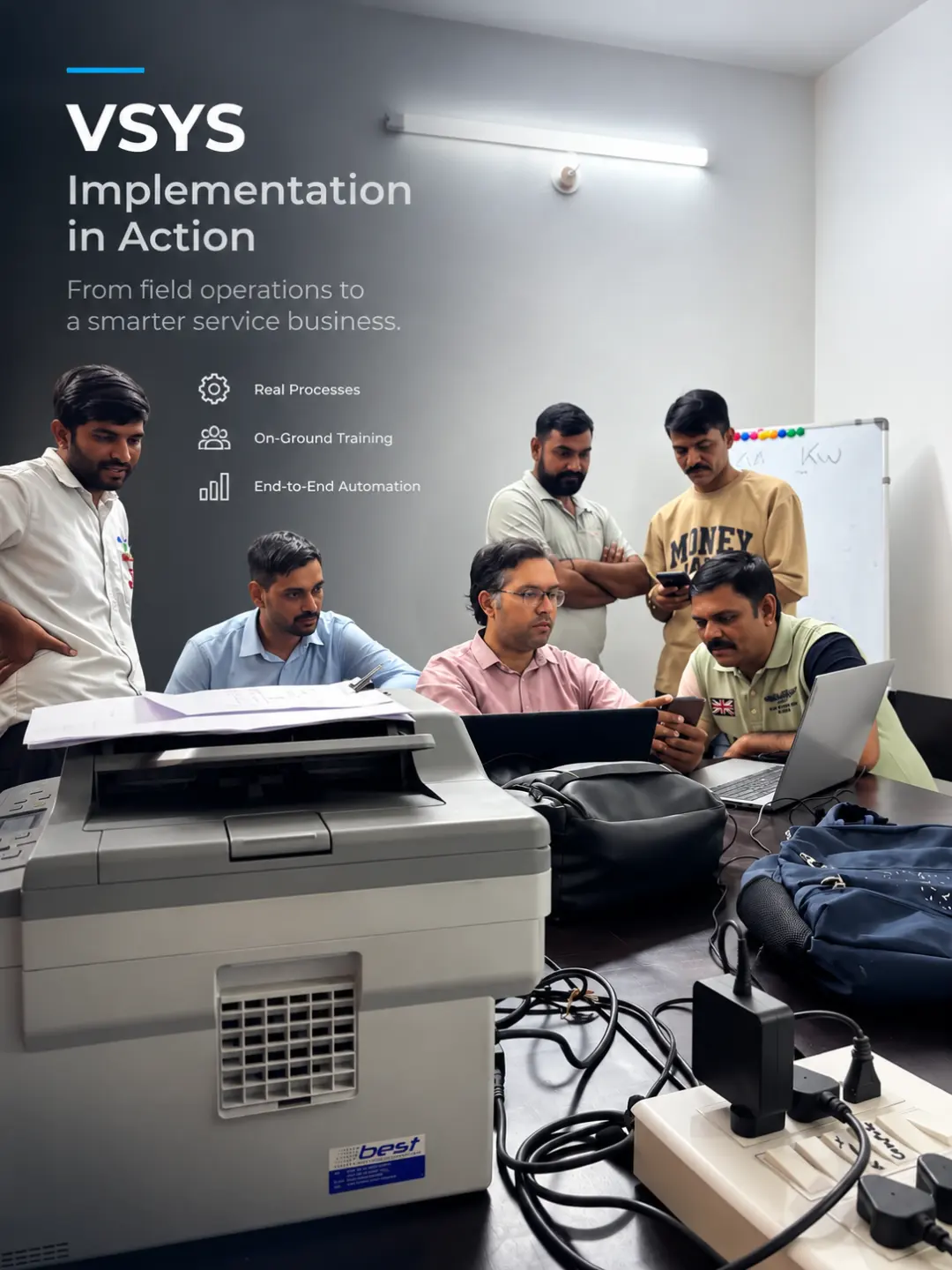
VSYS implementation in action — real processes, on-ground training, end-to-end automation.
Observe
Understand
Design
Build
Test
Train
Learn
Refine
Implementation is part of the product — not a hand-off that happens after it.
The Key Decision
We chose trust over tracking.
GPS and continuous location tracking can be entirely appropriate for certain businesses and use cases. For VSYS, we deliberately chose not to make employee location tracking the basis of accountability. Our approach is trust, SOP, accountability, automation and visibility — not surveillance.
"Trust does not mean lack of accountability. It means accountability is created through the process, not through surveillance."
Location Data vs Operational Data
Two different questions, two different systems.
- Where is someone right now?
- What happened?
- What is happening?
- Who owns it?
- What happens next?
- Is it complete?
"Location is one type of information. Operational information is something completely different."
SOP As The Foundation
The real control system is the SOP.
Software should not simply digitise an inefficient process. It should follow a defined sequence.
Understand
Simplify
Structure
Digitise
Automate
"The system should remember. The employee should execute. The manager should guide. The SOP should provide the structure."
End-to-End VSYS Flow
One connected system, from first lead to service planning.
Sales Journey
Lead
Enquiry
Requirement
Follow-up
Quotation
Negotiation
Order
Delivery & Service
Installation / Delivery
Service
Engineer Action
Spare Parts
Closure & Continuity
Service Report
Customer Confirmation
Closure
After-Sales
Service Planning
Sales
Business activity and next action — not location.
GPS is not the primary sales-control mechanism in VSYS. Sales visibility comes from lead management, customer requirements, follow-ups, quotations, negotiations, clear next actions, opportunity progression and clear ownership — the things that actually determine whether a deal moves forward.
Service
Continuity and history, at every step.
Service Request
Assignment
Engineer Action
Diagnosis
Work
Service Report
Customer Confirmation
Closure
Spare Parts
Service and inventory, connected.
When a service job identifies a spare-parts requirement, that requirement connects directly into the inventory process — instead of being communicated informally after the fact.
Service Reports & Customer Confirmation
Structured reporting. Confirmed closure.
A consistent service-report structure and a customer confirmation step turn every visit into a usable historical record — not just a completed task.
After-Sales & Service Planning
Completing a service shouldn't mean losing the customer.
Customer history, machine history, previous service, parts used and future requirements stay connected — ready for whoever plans or handles the next visit.
Quick Actions
"People don't want to operate software. They want to complete work."
The software should reduce friction, not create another administrative burden.
Quick follow-up actions
Simple service reporting
Easy part selection
Clear assignments
Visible pending actions
Clear next steps
Automation
Automation should follow the SOP.
Understand Process
Define SOP
Digitise
Automate Repetitive Work
- Quotation follow-up
- Service report workflow
- Spare-part consumption
- Future service requirements
- Pending actions
Team Engagement, Not Surveillance
We build systems for teams, not systems to watch teams.
- Sales sees customer information.
- Service sees customer and machine history.
- Engineers get the information required for the job.
- Spare-parts teams understand the actual requirement.
- Management sees pending work.
The system becomes a shared operational environment, not a surveillance tool.
Reducing Dependency On Individual Memory
From asking around, to just knowing.
- "Ask the person."
- "Check WhatsApp."
- "I think it was done."
- "Maybe someone followed up."
- System remembers.
- Responsibility is visible.
- History is available.
- Next action is clear.
Human Implementation
We use tools. But we love humans and interaction.
We use software. We use automation. We use dashboards. We use digital workflows. But our implementation philosophy is human-first — because software can tell us what a workflow is supposed to do, while people can tell us why the workflow actually works that way.
Implementation Is Team Building
Participants, not just users.
People who take part in implementation don't just become software users. They become participants in the process — they understand why a workflow exists, can suggest improvements, understand dependencies, and see how their work affects other departments.
The VSYS Implementation Loop
A loop, not a one-time rollout.
People
Process
SOP
Technology
Training
Feedback
Refinement
Automation
Continuous Improvement
What Makes VSYS Different
Eleven decisions, one connected system.
The Five Questions
Every piece of work answers all five.
What happened?
The system retains history.
What is happening now?
Current status is visible.
Who is responsible?
Ownership is clear.
What happens next?
The SOP guides the next action.
When is it complete?
Closure follows the defined process.
"Don't build software and ask people to adapt their business to it. Understand the business, work with the people, establish the SOP, and build the technology around it."
Frequently asked questions
How did Fistreet implement VSYS?
Through ground-level study — sitting with the team, studying real documents and observing the work — then designing, building, testing, training and refining in a continuous loop, rather than working only from online meetings and requirement documents.
What role do SOPs play in the implementation?
The SOP is the real control system: the process is understood, simplified and structured first, then digitised, and only then automated.
What does the system automate?
Quotation follow-up, the service report workflow, spare-part consumption, future service requirements and pending actions — all following the defined SOP.
Build a business system around the way your business actually works.
At Fistreet, we work with businesses to understand their operations, structure their processes and build technology around the way their teams actually work.